The Colonel Writes To No One..
April 22, 2014 People No Comments
Gabriel Garcia Marquez (6 March 1927 – 17 April 2014)

Gabriel Garcia Marquez (6 March 1927 – 17 April 2014)
It was an act of great generosity for a master of Khan sahib’s stature to have given so much so willingly to students of limited musical training and little or no knowledge of Hindustani music.
Regardless of their background, Khan sahib took his students seriously and required that they take themselves, music, and the labor of music (practicing, what else) seriously.
During my short time at the Ali Akbar College years ago, I also got to experience the genius of Khan sahib. His instrumental classes consisted much of the time of him composing on the spot, singing the composition to the students in Sargam or playing it on the Sarod, and explaining the theoretical issues that the piece touched on. The students would play back the compositions to him. In the singing classes I have seen him repeatedly pickup an old poetry book, choose a poem, and by the end of the class he will have composed a masterpiece which we will have all learned.
I have also seen the devotion of his students to the music and their great love and respect for Khansahib.
I am deeply grateful for the honor of having attended his classes, if only briefly, and deeply saddened for Khansahib’s passing.
I haven’t published new posts for a few months, mostly because I’ve been busy. I am still busy, but musifying means a lot to me, and apparently something to a few others since the blog receives more hits today than it did last year when I was writing daily.
It has never been interesting for me to make the blog a personal thing. It was always and will continue to be about the work. I will make its work more manageable by writing in parts and publishing about once or twice a week rather than daily.
I have a few things in mind I want to work on, but I also welcome your suggestions or question about things to discuss in the near future.
Saed.
Fasten yourself to the sun, Mahmoud,
So that your words can be read on the particles of dust when dust is all that is left to make kites with..
The Samai form is prevalent in both Arabic and Turkish art music. Though I couldn’t find out exactly when and where the form assumed it’s modern shape, it seems to be fairly accepted that the form is about 200 years old. By some accounts it is as old as 300 years. It is also generally accepted that the form is of Ottoman origin: although the its exact place of birth in the vast Ottoman empire of 200 years ago has not been established, by most accounts it was born in Turkey. Since the 19th century, the art-musical form has been popular both across much of the Arab world, as well as in Turkey.
In this essay, I am going to touch on the different aspects of the form that are of interest both to the performer and to the musicologist.
Read the rest…
Why would a oud buzz?
There are many possible reasons. In this post I will list the reasons that I have encountered in the past, and try to give enough information to help you identify why your oud is buzzing.
Fixing the problem is a different story. Some repairs are fairly easy and require no special tools or experience. Others, especially the ones related to the fingerboard, require expertise and/or special tools and, therefore, might require the attention of an instrument repair person. I will try to give enough information for you to make an informed decision about whether you should attempt to do the repair or whether you should hire a repair person to do it. Read the rest…
What would you say if I told you that you can take complete music courses for free at excellent music schools. Well, first a cautionary note: this is not for everyone. No the schools woun’t turn you down, but it’s a question of whether or not you are an autodidact or not.
However, if you do have the drive, discipline, and interest to do it on your own, you should check out some of the music coursework available online for free. Read the rest…
Making music is not necesserily the most earth damaging social phenomenon. But we can, and should, do what we can to to minimize our impact on the planet.
Are there things that a musician can do to reduce the damage that their music making causes? Well, I can think of a few, and invite you to participate in this discussion and share your advice. Read the rest…
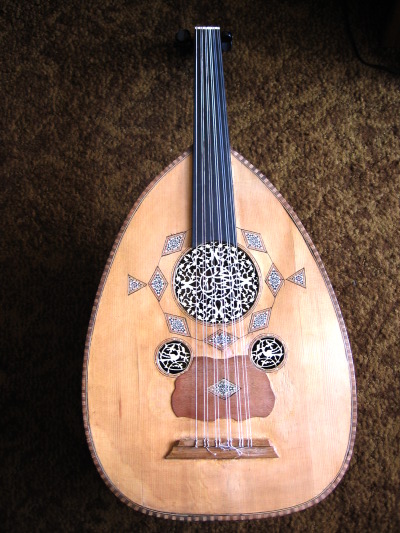
Last month, as I was preparing to put the final touches on the Nahhat: adding a fingerboard extension, making sure all the braces are tightly glued, gluing a few small cracks in the face (the oud’s face, that is), and gluing the rosette back on, a new member of the AOSF, nay player Hector Bezanis, mentioned in passing that he is an expert on wood. He offered to help. And boy did he help..
Hector, a master wood carver, had all the expertise, tools, and even wood, that I could have dreamt of. Quickly I did some calculations and took some measurements, and gave him the exact specifications of the fingerboard that allows for maximum playability and beauty. He took it from there, he cut the perfect ebony fingerboard, and carved the bottom of it so that it will fit snugly over the imperfections of the warping face. I went home and glued it without a problem, and within twenty four hours I had the fingerboard. The action was exactly as I had invisioned it: under an eighth of an inch at the fifth.
Hector also introduced me to another master craftsman, Giorgio di Costanzo, an expert on antique restoration and wood finishing. I was looking for an approach to do the final cleanup of the face, using materials that would clean the face and then evaporate leaving no trace. Giorgio, immediately identified the different materials that are needed to clean the oils, epoxy, and dirt that had become embedded in the wood.
The result?
Judge for your self:
In the first three parts of this series, I addressed the problematic aspects of talking about Arab avantgarde cultural activity. The reason a problem exists are ambiguities related to the term avantgarde, and the fact that the term, by now, has connotations resulting from its usage in the context of western avantgarde music and cultural activity.
I would like to close this series by touching on some of the unique characteristics of Arab avantgarde cultural activity in the twentieth century with a focus on music. Read the rest…